When the moment comes to choose between financial outsourcing and an in-house hire, most SME managers lean toward hiring. They have someone physically present, they know the person, they feel they control the process. The problem is they rarely run the full numbers: they see gross salary, add the charges roughly, and stop there. The rest stays invisible.
What follows is an honest comparison between the total cost of an in-house admin/finance hire and an outsourced financial management service on a retainer. There's the comparison table, the risks the numbers don't capture, and a practical way to decide for your company's profile.
What an in-house admin/finance hire really costs
Before comparing anything, you need to know what actually goes into the real cost. Gross salary is only the starting point.
Salary and mandatory charges
In 2026, the gross salary for a finance officer or analyst in Portugal typically sits between €28,000 and €30,500 a year. On top of that comes the employer's Single Social Tax, 23.75% of gross pay, which adds a further €6,650 to €7,250 a year. Add the holiday bonus, the Christmas bonus and work-accident insurance, which are mandatory and go into the total cost without exception. On these charges alone, annual cost already tops €36,000.
The costs that don't show up on the cost sheet
Annual training, €500 to €1,500. Equipment and licences, €1,000 to €2,000 upfront. And onboarding time: the first weeks where the employee is learning processes and the manager is explaining, reviewing and correcting, a real opportunity cost that never gets booked anywhere.
The consolidated total estimate lands between €36,500 and €42,000 a year — that is, €3,040 to €3,500 a month.
What's included in an external financial retainer
Financial outsourcing is not a black box, nor a vague consulting arrangement. It is a defined scope of work, with a fixed monthly price and clear responsibilities.
Retainer models in Portugal: price ranges and scope
The most common models rest on a fixed monthly fee per service package, sometimes with a variable component above a certain volume. In market terms: basic administrative and accounting services run €500 to €1,500 a month; a full operation, with accounts receivable and payable, bank reconciliation, invoicing, payroll processing and monthly reporting, typically runs €1,500 to €4,000 a month; operations with management control and cash flow forecasting can reach €8,000 a month.
Start-up and transition costs to plan for
Every transition carries one-off costs: initial diagnosis, process mapping, setting up access and systems, and a period of running in parallel during the first weeks. It would be dishonest to ignore them. The difference is that they are one-off, not recurring, and they amortise over the contract. Compare them against the onboarding cost of an in-house hire, which exists just as much and is rarely counted.
The side-by-side comparison
The table below considers a Portuguese SME with 5 to 30 employees, over a twelve-month period.
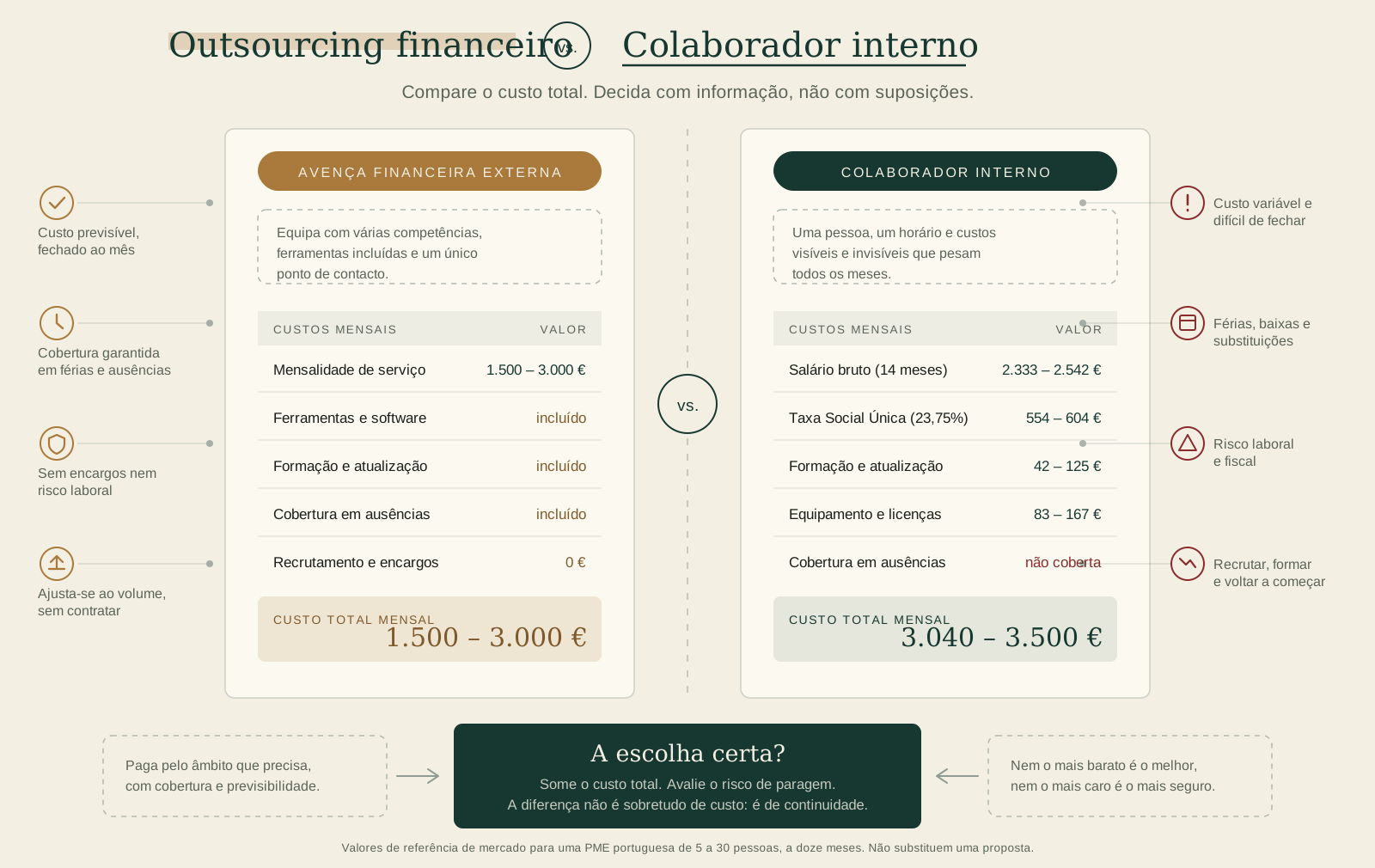
| Component | In-house employee | External financial retainer |
|---|---|---|
| Salary or base monthly fee | €28,000 – €30,500/year | €18,000 – €36,000/year |
| Employer social charges (23.75%) | €6,650 – €7,250 | — |
| Annual training | €500 – €1,500 | — |
| Equipment and licences | €1,000 – €2,000 | — |
| Internal management and supervision | Real opportunity cost | Minimal (single point of contact) |
| Risk of absence or replacement | High, no immediate cover | Low, structured team |
| Exit cost | Variable, by seniority and termination type | Per contract terms |
| Estimated annual total | €36,500 – €42,000 | €18,000 – €36,000 |
| Average monthly cost | €3,040 – €3,500 | €1,500 – €3,000 |
What the table shows at a glance
For most SMEs under 30 employees, the total cost of outsourcing lands under €3,000 a month even at full-operation scope, while an in-house employee costs €3,040 to €3,500 a month before factoring in departure risk or replacement costs. The gap may not look dramatic in any single month, but it holds consistently over time. In year one, the outsourced model's start-up costs narrow the gap. From year two on, the difference compounds.
What the numbers don't capture
An honest comparison cannot stop at euros. There are variables with real impact that show up in no table at all.
The risk of depending on one person
There's a scenario any experienced manager recognises: the sudden departure of the one person who knows where the files are, how payroll gets processed, and who the supplier contact is for invoice disputes. It's not an exception, it's a pattern. When that person leaves, the cost isn't just replacement: it's the urgency, the loss of continuity, and exposure to mistakes not caught in time.
It's the same problem covered in detail in the article on key-person risk, and no hire solves it on its own — it just moves the dependency to a different name.
Scalability and flexibility
An in-house employee has fixed scope and fixed cost, regardless of the month's volume. When the company grows, you need to hire more; when the month is slow, the cost stays the same. A retainer model adjusts scope as the company evolves. For SMEs with irregular growth, that has direct economic value.
How to decide for your company's profile
When an in-house hire makes sense
- High transaction volume that justifies a dedicated full-time presence.
- Very high sector-specific technical knowledge, hard to hand off.
- Size that already justifies a structured finance department, with more than one person.
As a practical reference, not a threshold derived from any formal study, companies above 50 employees and over €3 million in revenue are often close to the point where an in-house team starts to make economic sense.
When outsourcing is the rational choice
For most SMEs between 5 and 30 employees, the profile leans toward the outsourced model. Answer these questions:
- Are financial decisions made off the bank balance instead of structured data?
- Is payroll processing a monthly scramble dependent on one or two people?
- Is there no 90-day cash flow forecast?
- Does documentation reach the accountant disorganised or late?
- If your admin employee left tomorrow, would you know exactly what to do in the first 48 hours?
- Is the cost of an in-house hire a fixed overhead you'd rather make more predictable?
If you answered yes to three or more, the retainer model is, for this profile, the more rational choice. Treat this as practical guidance, not a formula.
A typical scenario, and what changes in it
The scenario below does not describe a specific client: it is a composite built from situations we see often in the Portuguese market, meant to make the comparison tangible.
A B2B services company, twelve employees, revenue close to €800,000 a year. Total dependence on one admin employee who handles everything: invoicing, collections, payroll processing and document organisation for the accountant. If that person leaves unexpectedly, the manager is left with no documented processes, no cash flow forecast, next month's payroll at risk, and no clear picture of which clients are overdue.
Under a retainer at the Management tier — invoicing, collections, bank reconciliation, payroll processing and the monthly Zelo Report on the 5th — cost is fixed and known, cover does not depend on one person, and within about 60 days there is a 90-day cash flow forecast and a set of indicators to decide from. The gain is not mainly about cost: it is about continuity.
Which is the better option for your SME
The real math rarely favours in-house hiring for SMEs under 30 employees, and the risk of depending on a single person makes that imbalance worse. Outsourcing on a retainer offers cost predictability, team-level cover, and scalability without the fixed overhead of a full-time employee.
If you want to work out which option fits your company's actual profile, Zelo runs an initial diagnosis of the real state of your financial operation. It's not a sales meeting: it's an assessment of what's working, what's at risk, and what would be worth structuring. The choice between hiring or outsourcing gets a lot simpler once the operation is actually mapped out.